

commercial roofing
What to Expect During a Commercial Re-Roof: A Project Man...
From pre-construction planning to final punch list — a week-by-week walkthrough of a commercial re-roofing project, with checklists for minimizing business d...
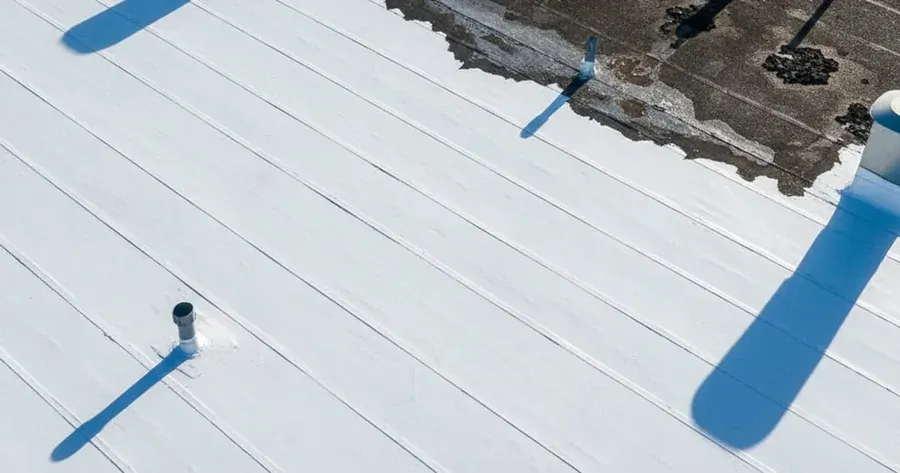
What to Expect During a Commercial Re-Roof: A Project Manager’s Timeline
A commercial re-roofing project on a 100,000-square-foot building is not a renovation — it’s an operational event. Done well, a five-week project barely registers to the tenants below. Done poorly, it generates water intrusion complaints, HVAC disruptions, and a punch list that stretches into the following quarter. The difference between those two outcomes is almost entirely in the pre-project phase, not the installation phase.
This is a week-by-week walkthrough of how a commercial re-roof unfolds on a building of that scale — what happens each week, what decisions are made, and what facility managers should be verifying at each stage. If you’ve already determined that your roof needs replacing and you’re engaging contractors, this is the operational context most bid documents don’t give you.
Pre-Project: Site Assessment and Scheduling
The pre-project phase starts with a thorough site assessment — not a sales call. A qualified contractor will walk every drain, review the existing roof assembly documentation, core-cut at minimum three locations to assess insulation condition and deck integrity, and deliver a written scope before a contract is signed. If a contractor skips the core cuts, that’s a red flag: they’re estimating blind.
The site assessment drives the specification. For an occupied commercial building, the spec determines sequencing — specifically, which quadrants of the roof get torn off in what order, and how the crew manages weather exposure during active tear-off. A competent project manager will divide the roof into work zones of no more than 20,000–25,000 square feet, ensuring that no more than that area is ever exposed simultaneously.
“The number one source of warranty disputes on re-roofing projects is inadequate pre-construction documentation. When we hand a building owner a 25-year warranty, we need to know exactly what we installed it over. That starts with cores, not guesses.”
Pre-project deliverables the facility manager should request in writing before mobilization: a detailed phasing plan, a weather contingency protocol, a daily communication procedure for active tear-off days, confirmation of permit status, and emergency contact numbers for the project superintendent. The pre-project phase also includes coordination with HVAC contractors if any rooftop units are being disconnected and reconnected during the project.
Week 1: Tear-Off and Deck Inspection
Tear-off is the most disruptive week of the project and the most information-rich. As each section is stripped, the crew — and the project manager — is looking at the structural deck in real time. What they find drives the scope and sometimes the budget.
Most commercial re-roofing contracts include a unit price allowance for deck repair: typically $3–$8 per square foot for steel deck patching, $6–$12 for wood deck replacement. Facilities managers who don’t have a pre-negotiated unit rate embedded in their contract often discover that the deck repair cost is the largest unforeseen expense. Get the rate in writing before week one starts.
During tear-off, the crew should be sequencing their work so that fresh substrate is never left exposed overnight or over a weekend. Industry standard is to install temporary protection — typically a polyethylene vapor barrier secured with ballast — on any exposed deck before work stops each day. Verify this is happening. Skipping this step is how interior water damage occurs during an otherwise well-managed project.
Week 2: Insulation and Substrate Preparation
After tear-off and deck repair, the insulation layer goes down before any membrane touches the roof. On most commercial re-roofs in Texas and Colorado, this means polyisocyanurate (polyiso) insulation board — typically 2–4 inches thick depending on the energy code requirements for the building’s climate zone and occupancy type.
The insulation layer is where the thermal performance of the finished system is determined. Most of it is invisible once the membrane goes on, which means this is the week to ask your contractor two questions: What is the published R-value per inch for the polyiso specified, and is the board being installed with staggered joints? Unstaggered joints create thermal bridging — a gap in performance that doesn’t show up visually but shows up on energy bills.
Insulation attachment — mechanically fastened vs. fully adhered vs. ballasted — matters for the membrane system above it. A TPO membrane over a fully adhered insulation layer performs differently under wind uplift than TPO over mechanically fastened board. In Texas, where high-wind events are common, verify that the attachment method meets FM Global or ASCE 7 wind speed requirements for your geographic zone before the insulation layer is locked in.
Weeks 3–4: Membrane Installation and Flashing
The membrane installation phase is the longest and, technically, the most consequential. For a TPO system, this means rolling out membrane sheets, overlapping seams, and heat-welding every seam to a minimum 1.5-inch wide fused bond. The quality of those welds determines the roof’s performance for the next 20 years. Probe testing — using a seam probe tool on every linear foot of welded seam — is not optional quality control, it’s the delivery standard. If your contractor doesn’t have a documented probe-testing protocol, ask why.
Flashing installation typically happens in parallel with membrane installation — not after. Pipe boots, curb flashings, HVAC equipment flashings, parapet wall terminations, and edge metal are all being installed while membrane crews work the field. The scheduling coordination here matters: a membrane crew that races ahead of the flashings crew leaves unsealed penetrations overnight. On an occupied building, that’s an unacceptable exposure window.
For buildings with numerous HVAC penetrations — a warehouse might have 20 or more rooftop units — the flashing phase alone can add two to three days to the overall schedule. Build this into your expectations when reviewing contractor timelines. A bid that promises a five-week project with 30 RTUs is likely underestimating the flashing phase.
Week 5: Final Inspection and Punch List
The final week is verification work. A professional re-roofing project should conclude with a formal drain flow test on every interior drain, electronic leak detection (ELD) or flood testing on suspect areas if warranted, a visual probe test of all field seams, photo documentation of every penetration flashing, and a written punch list issued to the contractor before the project is called complete.
Warranty activation is also a week-five task. Most manufacturer warranties — GAF EverGuard, Carlisle SynTec, Firestone Building Products — require the contractor to submit a warranty registration form within 30 days of project completion. Confirm the date of submission and get the warranty certificate number before your final payment is released. Releasing final payment without the warranty certificate in hand means you may have to chase it after the fact.
“We do flood testing on any drain that showed ponding evidence during the pre-project assessment. It adds half a day to the project, but it closes the loop before we hand over the warranty paperwork.”
The punch list process should be collaborative, not adversarial. A contractor who resists a walk-through inspection before final payment is a contractor who knows their work has open items. Expect a thorough contractor to initiate the walk-through, not wait to be asked. Any item that cannot be corrected before final payment should be tied to a written holdback amount — typically 10% of the contract value — with a defined completion date.
Managing Business Disruption During a Re-Roof
On an occupied commercial building, re-roofing disruption falls into four categories: noise, odor, debris, and interior access. Managing all four requires active coordination between the project superintendent and the facility manager — not a set-it-and-forget-it handoff.
Noise is worst during tear-off and unavoidable. The practical mitigation is scheduling tear-off sections over unoccupied or low-occupancy areas first, and notifying tenants of daily work zones 24–48 hours in advance. For industrial buildings this is rarely a significant issue; for office buildings or medical facilities, it requires active scheduling around critical meetings or procedures.
Odor from modified bitumen torch-down or SEBS coating applications is the category most facility managers underestimate. The smell of heated asphalt compounds is significant and can penetrate HVAC intake systems. Coordinate with your HVAC contractor to temporarily recirculate air rather than drawing fresh outside air during torch-down operations in adjacent zones. For TPO and EPDM systems installed without hot adhesives, odor is minimal.
Debris management — membrane scraps, fasteners, packaging — should be cleaned daily. A professional crew cleans to bare deck every evening. Specify this in your contract and enforce it. Fasteners left on pavement or walkways create liability; packaging left on the roof creates drainage blockages that can cause your new roof to fail faster than the old one did.
For commercial roof replacement projects on occupied buildings, the facility manager who has reviewed this timeline and built it into their stakeholder communications will have a materially better project experience than one who is reacting to each phase as it arrives. The roof project isn’t disrupting your business — the lack of preparation is. Get ahead of it four to six weeks before mobilization, and the five weeks of active work become predictable rather than reactive.
Start Your Re-Roofing Planning
Get a pre-project assessment that includes core samples, a phasing plan, and a complete scope before any contract is signed.
For the service page this article supports, see commercial roofing contractor.
Related reading: /blog/working-with-general-contractors-roofing-timeline/ and /blog/what-happens-during-roof-inspection/.