

storm damage
Will Insurance Cover Emergency Roof Repair? What Your Pol...
Most homeowner's insurance covers emergency roof repair caused by sudden damage events. Learn what's covered, what's excluded, and how to protect your claim.
Home › Resources › Emergency Roof Repair
Will Insurance Cover Emergency Roof Repair? What Your Policy Actually Says
The most common question after a storm isn’t “who do I call?” — it’s “will my insurance actually pay for this?” The honest answer is: probably yes, but the coverage depends heavily on the cause of damage, how your policy is structured, and what steps you take in the first 48 hours after the event. Understanding the mechanics of your homeowner’s policy before you file saves time, money, and the kind of frustration that comes from a surprise denial.
Standard homeowner’s insurance policies (HO-3 and HO-5 forms, which cover the majority of single-family homes) include dwelling coverage under “Coverage A.” This coverage protects the structure of your home — including the roof — against sudden and accidental damage from specific covered perils. For most homeowners in storm-prone markets like Dallas-Fort Worth, Denver, Kansas City, and Wichita, the relevant covered perils are:
-
Windstorm (including tornado and straight-line winds)
-
Falling objects (including tree strike)
-
Weight of ice, snow, or sleet
If the emergency roof repair is needed because of one of those perils, it is almost certainly a covered event — subject to your deductible and any policy exclusions that apply. The question is never simply “is my roof covered” but rather “is this specific type of damage, caused by this specific event, covered under my specific policy structure?”
The two categories that most often create disputes at claim time are wear and tear and pre-existing damage. Insurers are not required to cover the cost of replacing a roof that has reached its actuarial end of life, even if a storm event contributed to the final failure. If your roof was 22 years old before the hail event, the adjuster will document its condition and the insurer may calculate the claim payout using an actual cash value (ACV) methodology rather than replacement cost value (RCV) — or deny the claim entirely if the underlying condition was the primary cause of failure.
The Sudden vs. Gradual Damage Test
Every HO-3 policy contains language that limits coverage to sudden and accidental damage. This phrase is the primary battleground in roof insurance disputes. The adjuster’s job is to determine: did this damage happen suddenly and accidentally (covered), or did it develop gradually over time through normal deterioration (excluded)?
The tests adjusters use in practice:
-
Storm correlation: Is there verifiable storm activity on the date the damage is claimed? Adjusters cross-reference the reported event date against NOAA storm data and catastrophe event records. A hail claim in Dallas on a date with no recorded hail event is a red flag.
-
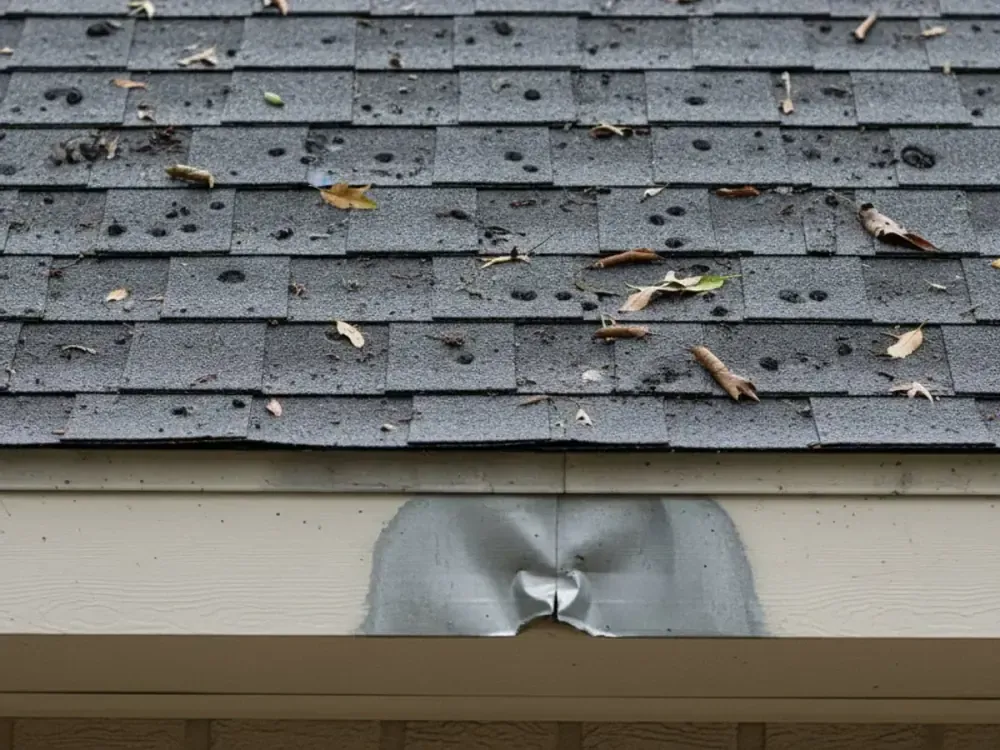
Damage pattern: Does the damage pattern match the claimed cause? Hail creates a distinctive bruising pattern on asphalt shingles — circular impacts with granule displacement, often visible as dark spots when viewed in raking light. Wind damage typically presents as lifted, buckled, or blown-off sections. A roof with “hail damage” that shows no impact bruising pattern is inconsistent with the claim.
-
Condition of surrounding materials: Is the damage isolated to the area of claimed impact, or is degradation visible throughout the roof system? Widespread granule loss, cracked tabs, and brittleness throughout the roof suggest chronic deterioration, not a single event.
-
Historical claim activity: Insurers review claim history. A property with multiple recent storm claims may receive more rigorous inspection on subsequent claims.
“The homeowners who have the hardest time with their insurance claims are the ones who delayed the repair for a year or two, then filed when things got bad enough to be unavoidable. By that point, the storm damage and the age-related deterioration are so intertwined that it’s genuinely hard to separate them — and the adjuster isn’t going to give you the benefit of the doubt on the ambiguous parts.”
How the Claims Process Works
The sequence from damage event to paid claim has six stages. Knowing each one prevents the errors that get claims delayed or denied.
-
Document immediately. Before any repair work begins — before the tarp goes on — photograph the damage area from every accessible angle with timestamped photos. If possible, photograph storm event evidence (hail on the ground, downed branches, neighbor’s visible damage). This establishes the condition at the time of the event.
-
File your claim promptly. Most policies require notice “as soon as practicable” after a covered loss. Waiting weeks or months to file — while continuing to live in the property without mitigating — can give the insurer grounds to reduce or deny the claim based on delayed reporting and failure to mitigate.
-
Perform and document temporary repairs. Your policy’s mitigation clause requires you to take reasonable steps to prevent further damage. Emergency tarping and spot repairs are appropriate here. Keep every receipt and photograph the work.
-
Schedule the adjuster inspection. Your insurer will assign an adjuster — either an employee adjuster or an independent adjuster under contract. The adjuster inspects the damage, documents the scope, and prepares a loss estimate. Do not proceed with permanent repair until this inspection is complete.
-
Review the adjuster’s estimate. You have the right to dispute an adjuster’s scope and valuation. If the estimate is significantly lower than contractor quotes, you can request a reinspection, hire a public adjuster at your own expense, or invoke the appraisal clause (available in most policies) to use a neutral umpire process.
-
Authorize permanent repair. Once the adjuster’s estimate is accepted or the dispute process is complete, permanent repair can begin. The insurer issues payment minus your deductible (and any depreciation if your policy pays ACV rather than RCV).
AOP vs. Wind and Hail Deductibles
The percentage deductible is the variable most Texas and Colorado homeowners underestimate. If your home’s Coverage A limit is $400,000 and your wind and hail deductible is 2%, your out-of-pocket exposure on a hail claim is $8,000 — before the claim pays a dollar. On a $15,000 roof replacement, that leaves only $7,000 in insurance proceeds. Understanding this number before a storm event is essential for financial planning.
Experienced adjusters inspect residential roofs systematically. They look at the field (the main roof surface), the penetrations (pipe boots, vents, skylights), the flashings (valleys, walls, chimneys), the ridge, the gutters, and any window screens or AC fins that would show hail impact independent of the roof. The latter two are particularly useful: aluminum window screens and AC condenser fins are highly sensitive to hail impact and provide corroborating evidence of hail event magnitude.
An adjuster who does not check screens, fins, and gutters is not running a complete inspection. If your adjuster skips these components, point them out — they strengthen your claim by demonstrating that the hail event was real and significant.
Four actions protect your emergency roof repair claim:
-
Photograph everything before and after temporary repairs. The timestamped photo set you build immediately after the event is the single most important asset in your claim file.
-
Get an independent contractor inspection before the adjuster arrives. A licensed contractor who documents the damage independently — and who can walk the roof with the adjuster — provides a professional second opinion that adjusters respect. Pro Exteriors provides pre-claim inspection documentation as a standard service in our operating markets.
-
Understand your policy before you file. Know whether you have ACV or RCV coverage, know your wind and hail deductible structure, and know your claim reporting timeline requirements. These are in your policy declarations page and your policy document.
-
Never waive your deductible. A contractor who offers to “cover your deductible” as a marketing offer is committing insurance fraud in Texas, Colorado, Kansas, and Missouri — it’s illegal and can expose you as a co-conspirator even if you weren’t aware of the scheme. Legitimate contractors charge a fair price for the work and do not absorb your deductible.
The vast majority of emergency roof repairs caused by storm events are fully payable under standard homeowner’s policies. The cases that result in denied or reduced claims share a common thread: delayed reporting, inadequate documentation, or damage that pre-dated the claimed event. Executing correctly in the first 48 hours after a storm is where claims are won or lost.
Get a Pre-Claim Inspection Before Your Adjuster Arrives
Pro Exteriors documents storm damage professionally — the photos and report that adjusters respect. Serving DFW, Denver, Wichita, and Kansas City.
What to Do When Your Roof Leaks: A Step-by-Step Guide
Emergency Roof Tarping Costs: What You’ll Actually Pay in 2026
How to File a Roof Insurance Claim: The Complete Step-by-Step Guide
© 2026 Pro Exteriors — Prepared by AIA4 Pro Exteriors — Maren Castellan-Reyes, Senior Director, Website & Application Experience
For the service page this article supports, see storm damage roof repair.
Related reading: /blog/wind-damage-vs-hail-damage/ and /blog/what-to-do-when-roof-leaks/.