

commercial roofing
Metal vs. Membrane Roofing for New Construction: Performa...
A side-by-side comparison of standing seam metal and single-ply membrane roofing for commercial new construction—installed cost, service life, maintenance, e...
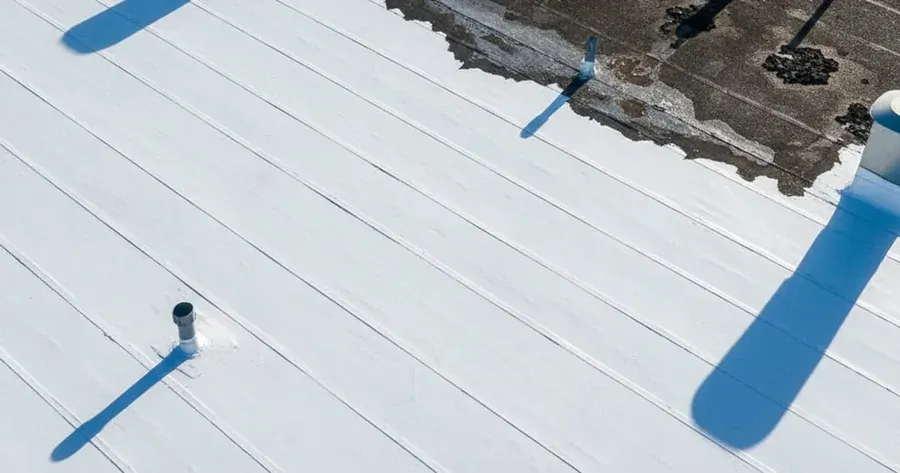
Metal vs. Membrane Roofing for New Commercial Construction: A Performance and Cost Comparison
-
Service Life and Maintenance
-
Hail and Impact Resistance
The metal vs. membrane decision in commercial new construction is not a question of which system is “better”—it’s a question of which system is appropriate for the specific building type, the owner’s investment horizon, the climate, and the budget. Both systems, specified and installed correctly, perform reliably for their design service lives. Specified incorrectly, either can be an expensive mistake that the building owner manages for decades.
This guide provides a direct comparison of standing seam metal and single-ply membrane (primarily TPO, the dominant membrane choice in commercial new construction) across the performance dimensions that matter for new construction specification decisions.
Standing seam metal roofing is the preferred system when: the building design calls for a slope of 2:12 or steeper; the owner’s investment horizon extends beyond 40 years; the building type makes roof access for maintenance difficult or costly; or the architectural expression of the building is premium and the roof is visible from grade or from adjacent elevated structures.
Single-ply membrane—TPO specifically—is the preferred system when: the roof is low-slope (below 2:12), which is the standard condition for most commercial new construction; the installed budget is constrained relative to the building’s total construction cost; the owner expects to sell the building within 15 years; or the building type involves high penetration density (HVAC equipment, conduit, exhaust systems) that makes the flashing complexity of a metal system impractical.
The cases where the decision is genuinely ambiguous—low-slope buildings on longer investment horizons, 2:12 slopes that could accommodate either system—are where the TCO analysis becomes decisive.
Standing seam metal roofing commands a significant installed cost premium over single-ply membrane. In the South-Central market in 2026, typical installed cost ranges for new construction are $14 to $22 per square foot for Galvalume or painted steel standing seam systems, versus $7 to $11 per square foot for 60-mil TPO mechanically attached on steel deck with polyiso insulation to R-20. Aluminum standing seam systems run $18 to $28 per square foot. These figures assume standard new construction conditions; complex geometries, high parapet walls, and high equipment density can push costs higher in both categories.
On a 100,000-square-foot building, the cost differential between a standard TPO assembly and a standing seam metal system is $700,000 to $1,100,000. That gap must be justified by a combination of extended service life, reduced maintenance cost, and any premium the building commands in the market for the metal system—whether in higher lease rates, stronger tenant retention, or a higher exit cap rate at disposition.
“The owners who choose metal on a 40-year hold and are disciplined about maintenance come out ahead. The owners who choose metal because it ‘looks better’ and then sell in year seven have overpaid by a significant margin. The investment horizon is the number that should drive the decision.”
Service Life and Maintenance Requirements
The service life advantage of standing seam metal is real and significant. A properly installed Galvalume standing seam system has a documented service life of 40 to 60 years; aluminum systems can exceed 60 years in corrosive coastal environments where steel would require periodic coating to maintain corrosion resistance. A 60-mil TPO system, well maintained, is designed for 20 to 25 years of service life, with coating extension potentially adding 10 to 15 years beyond that.
Maintenance requirements differ substantially between the systems. Standing seam metal roofing requires: annual inspection for sealant condition at penetrations and end conditions, periodic re-coating of sealant joints at panel terminations, inspection and re-tightening of any exposed fasteners (screw-down metal systems only—standing seam systems are concealed-fastener and have far fewer maintenance touchpoints), and gutter/conductor pipe maintenance where applicable.
TPO maintenance follows the schedule described in our guides on commercial roof maintenance programs and preventive maintenance practices. The annual maintenance cost for a well-maintained TPO system runs $0.12 to $0.18 per square foot per year; standing seam metal maintenance runs $0.05 to $0.10 per square foot per year, reflecting the system’s lower ongoing maintenance demand.
Energy Performance Comparison
Both system types can be specified to meet ASHRAE 90.1 energy code requirements, and both can achieve high SRI (Solar Reflectance Index) values with the appropriate finish. White TPO achieves SRI values of 85 to 100, qualifying for ENERGY STAR and most Cool Roof Rating Council (CRRC) program requirements. Painted or coated metal panels can achieve SRI of 35 to 75 depending on the coating color and finish; Galvalume bare metal achieves SRI of approximately 55 to 65.
The insulation layer underneath either system is the primary driver of whole-assembly thermal performance, and both system types accommodate the polyiso insulation depths required by ASHRAE 90.1. The distinction is in installation detail: standing seam metal systems can accommodate a thicker insulation assembly beneath the structural standing seam clips without the structural complications that affect some membrane systems at extreme insulation depths.
Hail and Impact Resistance
Hail resistance is a particularly important selection criterion in the South-Central and Mountain markets where Pro Exteriors operates. Texas, Oklahoma, and Kansas consistently rank among the top five states for hail claim frequency and severity. The roofing system’s response to hail depends on the membrane or panel characteristics, the insulation hardness beneath it, and the fastening pattern.
The Decision Matrix: Matching System to Scenario
Four scenarios account for most of the new construction decisions in the commercial market. First: a developer building a speculative distribution center for a 7-to-10-year hold before disposition. TPO is the correct choice. The installed cost savings relative to metal fund other improvements that increase the building’s lease competitiveness, and the system’s 20-to-25-year service life exceeds the expected ownership horizon by a comfortable margin.
Second: an owner-user developing a manufacturing facility they intend to own and occupy for 30 to 40 years. Standing seam metal is worth serious evaluation. The 40+ year service life eliminates a re-roofing capital event during the ownership period, and the lower maintenance burden over that period partially offsets the installation premium.
Third: a mixed-use commercial development where the roof is partially visible from an adjacent retail or hospitality component and appearance is a brand consideration. Metal offers an architectural expression that TPO cannot match, and the premium may be justified by the brand positioning of the overall development.
Fourth: a low-slope building of any type in a high-hail market like Dallas-Fort Worth, where insurance premium differentials between hail-rated and non-rated roofing systems are significant. Specify TPO or membrane with FM Severe Hail (SH) rating, or evaluate metal—both approaches reduce the long-term insurance cost that otherwise penalizes non-rated roofing in the Texas market.
For a broader framework covering all major system selection variables, see our guide on choosing a roofing system for new commercial construction.
Metal and Membrane New Construction Roofing
Pro Exteriors installs both standing seam metal and single-ply membrane systems for commercial new construction. We help developers and owner’s reps evaluate the right system for their specific building and investment profile.
Choosing a Roofing System for New Commercial Construction: The Decision Framework
Roof Design Considerations for Warehouses and Industrial Buildings
Energy-Efficient Roofing for New Commercial Buildings: What ASHRAE 90.1 Requires
For the service page this article supports, see commercial roofing contractor.
Related reading: /blog/preventive-roof-maintenance-checklist/ and /blog/infrared-vs-visual-roof-inspections/.