

commercial roofing
How Long Does a Commercial Roof Last? Lifespans by System...
TPO, EPDM, modified bitumen, metal — a data-driven breakdown of commercial roofing system lifespans, what accelerates degradation, and when to start planning...
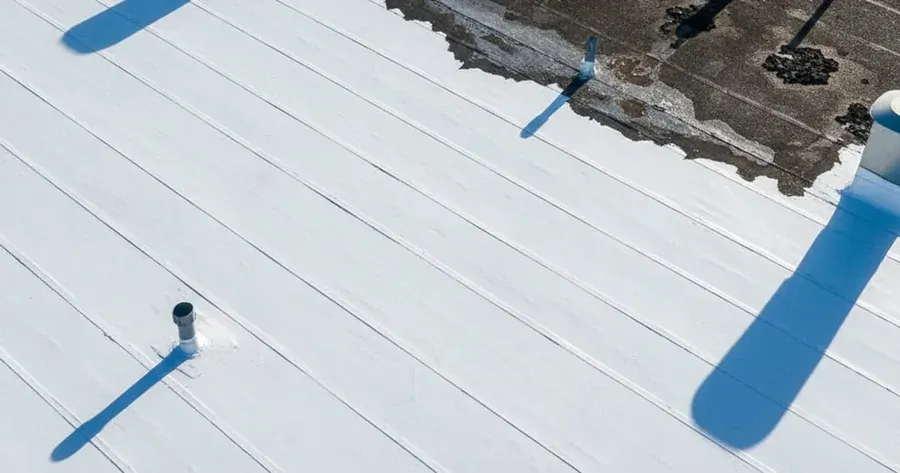
How Long Does a Commercial Roof Last? Lifespans by System Type
The most honest answer to “how long does a commercial roof last” is: it depends on four things — the system type, installation quality, maintenance history, and climate exposure. The manufacturer’s warranty is the floor, not the ceiling. A 20-year warranted system on a properly maintained building in a moderate climate can routinely exceed 25–30 years. The same system on a building in the Texas heat corridor with no maintenance program may struggle to reach 15.
What follows are design lifespan estimates for the major commercial roofing systems, the conditions that accelerate or extend them, and the planning framework that allows property owners to make capital expenditure decisions before they are forced into them by an active failure.
TPO: 20–30 Years Under the Right Conditions
Thermoplastic Polyolefin is the most-installed commercial membrane today, introduced at scale in the 1990s. As a relatively younger system than EPDM, TPO’s long-term performance data is still accumulating — the oldest installations are just now reaching 25–30 years of service. Performance at that age is strongly correlated with membrane thickness and installation quality.
Standard TPO is available in 45-mil, 60-mil, and 80-mil thicknesses. Lighter gauges (45-mil) have documented higher failure rates past 15 years, particularly around seam integrity and UV degradation at termination points. Premium 80-mil installations on well-maintained buildings have demonstrated service lives approaching 30 years in real-world conditions.
TPO performs well in high-UV environments (Texas, Colorado) because of its reflective white or light-colored surface — it reduces rooftop temperatures that can exceed 170°F on dark membranes, which directly reduces thermal cycling stress on seams. This reflectivity is also why TPO qualifies for Energy Star ratings and can contribute to LEED certification points.
“The biggest variable we see in TPO longevity is the seam quality from the original installation. A roof with properly heat-welded, tested seams throughout will hold up in ways that a roof with lap-sealed or poorly welded joints simply cannot. We have pulled up 22-year-old TPO roofs with seams that are still fully fused. We have also pulled up 10-year-old roofs that had failed at nearly every seam.”
EPDM: The Longevity Leader at 25–30 Years
Ethylene Propylene Diene Monomer has been in commercial service since the 1960s, making it the most field-proven of the single-ply membranes. The oldest EPDM installations still in service are well past 40 years — an extraordinary performance record that reflects both the material’s inherent durability and the benefit of decades of application refinement.
EPDM’s strength is its flexibility and resistance to UV degradation. The thermoset rubber composition does not become brittle with age the way some thermoplastics do — it remains pliable through decades of thermal cycling, which allows it to accommodate normal building movement without seam fatigue. Its primary vulnerability is adhesive seam failure: early EPDM installations used water-based adhesives that are now known to have poor long-term bonding, and many buildings with 1990s-era EPDM are experiencing seam failures in the adhesive layer rather than the membrane body itself.
Modern EPDM systems with factory-seamed tape or mechanically fastened seams address this vulnerability and are expected to reach 30-year-plus service lives with proper maintenance.
Modified Bitumen: 15–20 Years with Proper Maintenance
Modified bitumen is the performance successor to traditional built-up roofing (BUR), offering improved flexibility and cold-weather performance through polymer modification of the asphalt. SBS (rubber) and APP (plastic) variants are the two dominant types. Both have design service lives of 15–20 years under standard conditions, with APP systems generally showing slightly better UV resistance in high-sun climates due to their harder surface composition.
Modified bitumen systems are more susceptible to thermal shock than single-ply membranes — rapid temperature swings can cause surface cracking in APP systems and joint stress in SBS systems over time. In Texas and Colorado, where summer-to-winter temperature swings of 100°F or more are common, modified bitumen installations often trend toward the lower end of the 15–20 year range. Granule-surfaced cap sheets (which protect the asphalt from UV) outlast smooth-surfaced systems by 3–5 years in high-UV environments.
Metal Roofing: 40–60 Years but at What Cost?
Standing seam metal roofing has the longest service life of any commercial roofing system — field data from mid-20th century installations confirms 50–60 year service lives for Galvalume and painted steel systems with minimal maintenance. Aluminum and copper systems can exceed these figures. The upfront cost premium is substantial (typically 30–50% above single-ply), but the lifecycle cost — amortized over 50 years versus 25 — often makes metal the most economical choice for buildings where the owner intends to hold the asset long-term.
Metal is not appropriate for all commercial applications. Flat or near-flat roofs (slopes below 2:12) require concealed-fastener standing seam systems to prevent water infiltration at exposed fasteners — and these systems carry higher installation costs than through-fastened panels. Buildings with complex geometry (multiple HVAC curbs, penetrations, and changes in slope) incur significant flashing complexity costs that narrow the cost advantage.
What Actually Shortens Roof Life
Regardless of system type, the factors that consistently reduce service life below design expectations are:
-
Poor installation quality: Seam defects, inadequate fastening patterns, improper flashing geometry, and inadequate slope correction are installed at day one and compound for decades. A roof installed poorly will never perform to its design lifespan regardless of the material quality.
-
Standing water: Any membrane system subjected to prolonged ponding ages faster at the water contact zone. On TPO and EPDM, UV degradation at the water line creates surface crazing and micro-cracking. On modified bitumen, sustained moisture contact weakens the ply adhesion over time.
-
Undermanaged foot traffic: HVAC technicians, telecom crews, and maintenance personnel accessing roofs without walkway pads and path guidance create micro-puncture damage that accumulates over years into active leak points.
-
Skipped maintenance cycles: A bi-annual inspection that catches a blocked drain costs $300. The same blocked drain left two years catches up as ponding-induced membrane fatigue, then insulation saturation, then interior damage — a cascade that can reach $50,000 or more.
-
Thermal shock in extreme climates: The Texas heat corridor and Colorado hail corridor are genuinely harder on roofing systems than moderate climates. A 20-year warranty on a system installed in Dallas is earned under more stressful conditions than the same warranty on the same system in Seattle.
Planning the Replacement Cycle
The correct time to begin planning for commercial roof replacement is five years before you expect to need it — not when you are calling for emergency repairs. The planning horizon allows you to budget the capital expenditure properly, evaluate system options without time pressure, and potentially time the project to align with a lease renewal or property refinancing that makes the capital structure more favorable.
The practical trigger: when your current system is 75% of the way through its expected service life and showing any of the warning signs covered in our TPO vs EPDM vs PVC membrane comparison — increased repair frequency, insulation saturation trending upward, seam performance degrading — begin the replacement planning process. Do not wait for an emergency to force the decision on someone else’s timeline.
Get a Commercial Roof Replacement Estimate
Pro Exteriors provides lifecycle cost analyses with system recommendations for buildings across Texas, Colorado, Kansas, and Missouri — including 10-year total cost of ownership projections for every major system type.
TPO vs EPDM vs PVC: Which Membrane?
8 Signs Your Commercial Roof Needs Replacement
Commercial Roof Replacement Cost Guide
For the service page this article supports, see commercial roofing contractor.
Related reading: /blog/how-often-should-commercial-roof-be-inspected/ and /blog/how-insurance-claims-work-roof-repair/.