

storm damage
Hail Damage on a Roof: How to Identify It Before Your Ins...
Bruising, granule loss, dented metal — what hail damage actually looks like on asphalt shingles, metal roofing, and tile, with documentation tips that protec...
Home › Resources › Storm Damage Roof Repair
Hail Damage on a Roof: How to Identify It Before Your Insurance Adjuster Arrives
A hailstorm passes through in minutes. The damage to your roof persists for months—or until you file a claim and get repairs scheduled. The interval between the storm and your insurance adjuster’s arrival is critical. What you document during those first 48 hours determines whether your claim reflects the actual scope of damage or falls short of what your roof sustained.
This article teaches you how to identify hail damage before the adjuster arrives, what to photograph, and why a roofer’s assessment strengthens your position. The goal is straightforward: ensure your insurance company sees what actually happened to your roof.
What Hail Actually Does to Asphalt Shingles
Asphalt shingles are the most common roofing material across Texas, Colorado, Kansas, and Missouri. They’re also the most vulnerable to hail impact because of their composition: a fiberglass mat core, an asphalt base layer, and a granule-coated surface.
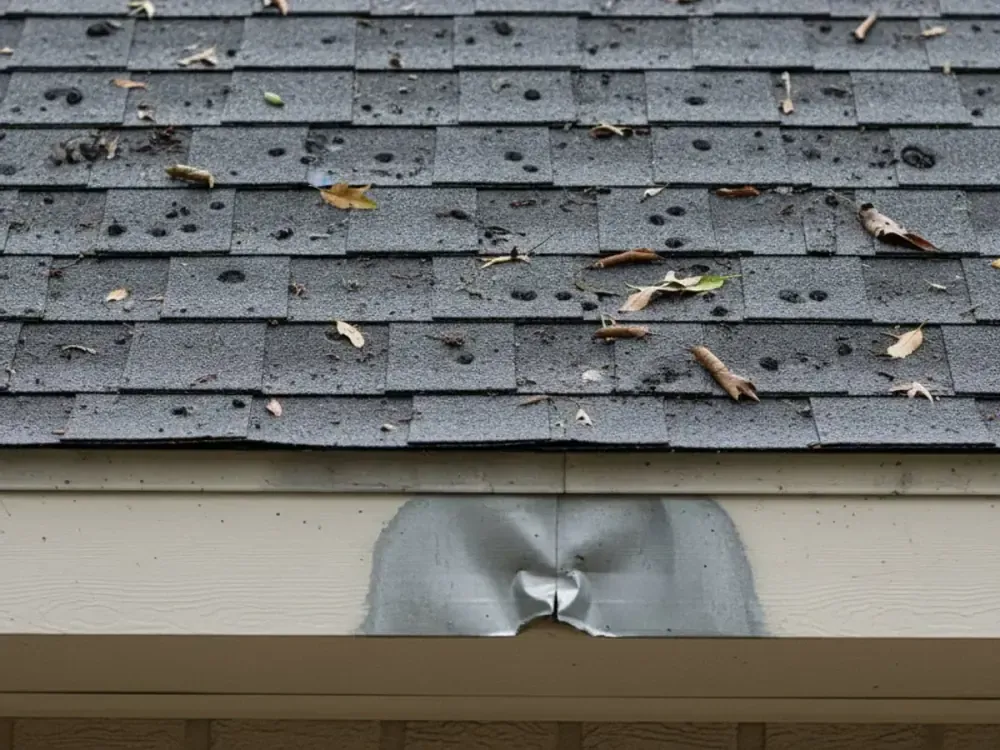
When hail strikes an asphalt shingle, it doesn’t always leave an obvious crater. Instead, hail damage typically manifests as:
-
Bruising or soft spots: The impact compresses the shingle without breaking the surface. You’ll feel a slight depression if you run your hand across it (carefully—don’t damage undamaged areas). The shingle feels softer than surrounding material.
-
Granule loss: Hail knocks off the protective granule coating, exposing the dark asphalt underneath. This creates dark spots or streaks on the shingle surface. Granule loss accelerates deterioration because UV exposure reaches the asphalt layer directly.
-
Cracking and splits: Larger hail or multiple impacts in the same area cause visible cracks radiating from the impact point. These cracks follow the grain of the fiberglass mat.
-
Punctures: In rare cases, severe hail creates actual holes. This is less common with modern asphalt shingles but does occur with golf-ball-sized hail or larger.
The critical detail: bruising doesn’t always break the surface. Many homeowners miss this damage because they’re looking for visible tears. An insurance adjuster trained in hail damage assessment will identify bruising as a legitimate claim item. Your documentation of bruising—through photography and a roofer’s report—prevents the adjuster from dismissing it as normal wear.
Hail Damage on Metal Roofing: Dents vs. Functional Damage
Metal roofing is increasingly common in Colorado and Kansas, where hail frequency is higher than Texas averages. Metal’s durability is one reason it’s chosen for high-risk areas. However, hail still damages metal roofs—the question is whether the damage affects function or merely appearance.
Insurance companies distinguish between these categories:
-
Cosmetic dents: A dent that doesn’t affect water shedding or structural integrity. These may not be covered depending on your policy language.
-
Functional damage: Dents that disrupt the roof’s ability to shed water, create pooling zones, or compromise the sealant layer. These are covered.
On standing-seam metal roofs, look for:
-
Dents along the seams themselves (these compromise the seal)
-
Dents deep enough to create a visible depression that water could collect in
-
Damage to the paint or protective coating that exposes bare metal (corrosion risk)
On metal shingles or panels, hail often creates a line of dents across the roof surface. Document the pattern and count the affected shingles. This data matters for your claim because it demonstrates systemic damage, not isolated impact.
Metal roofing’s advantage: damage is visible and measurable. You don’t have to interpret bruising. A dent either exists or it doesn’t. Photograph dents from multiple angles and with a scale object (a coin or ruler) in the frame to show depth.
Tile and Slate: Where Hail Breaks vs. Bruises
Tile and slate roofing, common in high-end residential properties across Dallas and Denver, respond to hail differently than asphalt or metal.
Tile (clay or concrete) cracks or breaks under hail impact. You’ll see:
-
Visible cracks running across the tile face
-
Chunks missing from tile edges
-
Broken tiles that have separated from the roof deck
Slate is harder than tile but also more brittle. Hail causes:
-
Clean breaks across the slate plane
-
Delamination (layers separating)
Unlike asphalt shingles, tile and slate damage is unambiguous. There’s no debate about bruising. A broken tile is a broken tile. This simplifies your claim documentation—photograph each damaged tile individually and note its location on the roof (front face, rear slope, etc.).
The complication: tile and slate replacement is expensive. Roofers must match the existing material, which sometimes requires sourcing discontinued products. Your insurance adjuster will likely recommend replacement of the entire roof section to ensure color and texture consistency. This is standard practice and should be reflected in your claim estimate.
Photographing Hail Damage for Insurance Documentation
Photography is your primary evidence. Poor photos weaken your claim. Strong photos accelerate approval.
Photograph within 48 hours of the storm, before rain, wind, or debris obscure the damage. Follow this protocol:
-
Wide shots: Photograph entire roof sections to show the pattern and scope of damage. Include the sky or a recognizable landmark in the frame to establish date and location context.
-
Medium shots: Focus on specific areas of concentrated damage. Show 4–6 shingles or tiles in a single frame to demonstrate the density of impact.
-
Close-ups: Document individual damaged shingles with a scale object (ruler, coin, or your hand) in the frame. This shows the adjuster the size and depth of bruising or dents.
-
Granule loss detail: If hail stripped granules, photograph the dark asphalt exposed underneath. This is critical evidence of impact severity.
-
Multiple angles: Photograph from ground level looking up, and if safe, from the roof itself. Different angles reveal damage that’s invisible from a single vantage point.
Store all photos with metadata intact. File timestamps prove when you photographed the damage. Don’t edit or filter photos—adjusting color or contrast can cause an adjuster to question authenticity. Submit originals.
Upload photos to cloud storage (Google Drive, OneDrive) immediately after taking them. This creates a backup and establishes a timestamp record independent of your phone or camera.
The Hail Size Threshold That Changes
Ready to Talk to an Expert?
Pro Exteriors serves commercial and residential clients across Texas, Colorado, Kansas, and Missouri.
Filing a Roof Insurance Claim: Step by Step
Wind Damage vs. Hail Damage
Working with Adjusters After a Storm
For the service page this article supports, see storm damage roof repair.
Related reading: /blog/temporary-vs-permanent-roof-fixes/ and /blog/filing-roof-insurance-claim/.