

commercial roofing
Extending Commercial Roof Lifespan: The Asset-Management...
How facility managers extend commercial roof service life by 8–15 years using coatings, drainage optimization, insulation integrity, and the financial data t...
Extending the Lifespan of Your Commercial Roof: The Asset-Management Case for Strategic Maintenance
A commercial roof has a rated service life. It also has an actual service life, which is typically 8 to 15 years shorter than the rated figure when maintenance is deferred and 5 to 12 years longer than the rated figure when maintenance is strategic. The gap between those two outcomes represents hundreds of thousands of dollars on a mid-size commercial building—and the decision about which outcome you’re tracking toward is made in the early years of the roof’s life, not at the end of it.
This guide is written for the facility director who needs to make the case internally for maintenance investment, and for the property owner who wants a clear-eyed picture of the financial levers available before a replacement conversation begins. The data below comes from NRCA and RS Means industry benchmarks, supplemented by field findings from Pro Exteriors’ commercial service work across the South-Central and Mountain regions.
Establish Baseline Data Before You Can Extend Anything
You cannot extend what you haven’t measured. The first requirement for a lifespan extension program is an honest condition assessment: the roof’s current age, the documented history of any past repairs, the membrane type and installation date, and the known problem areas from prior inspections. Without that baseline, every decision you make is reactive rather than strategic.
If the roof has never had a formal condition assessment, that’s the starting point. A qualified commercial roofing inspector evaluates membrane condition using both visual inspection and non-destructive moisture detection—typically infrared thermography or nuclear moisture scanning—to map wet insulation without cutting test cuts. That moisture map is the single most valuable document in the lifespan extension program: it identifies where insulation has already been compromised and where structural resources should be concentrated.
The assessment output should include a remaining useful life estimate, a prioritized repair list with cost estimates, and a recommendation on whether the roof is a candidate for coating extension or is already past the point where coating investment is justified. Not every roof can be extended; investing $2 per square foot in coating on a membrane that has 40 percent wet insulation is not extension—it’s deferred replacement with an expensive delay fee attached.
Coating Systems: The Primary Lifespan Extension Tool
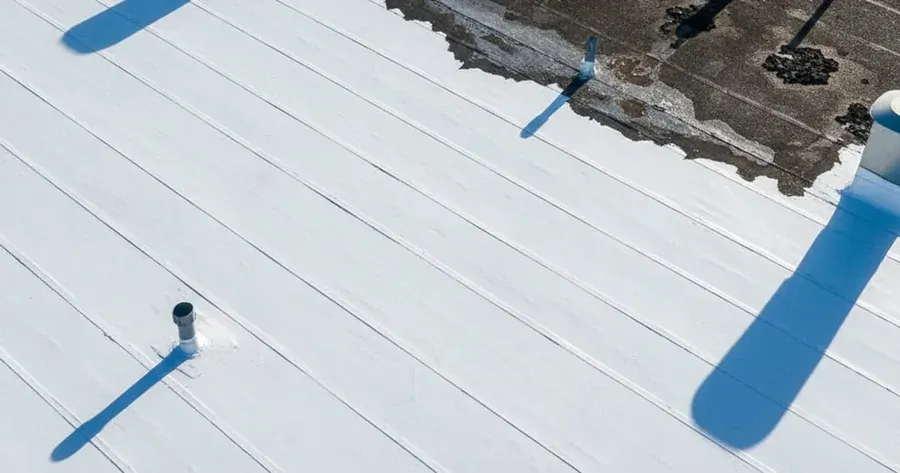
Fluid-applied roof coatings are the most cost-effective lifespan extension technology available for single-ply and modified bitumen commercial roofing. When applied to a structurally sound, dry membrane in good condition, a silicone or acrylic coating system adds 10 to 15 years of service life at a cost of $1.50 to $3.50 per square foot—compared to $6 to $12 per square foot for full membrane replacement. On a 50,000-square-foot roof, that difference is $225,000 to $425,000 in deferred capital expenditure per application cycle.
Coating systems work by restoring UV resistance and waterproofing integrity to a membrane that has oxidized but not yet failed structurally. They are not repair systems—they do not bridge open seams or inject saturated insulation. The membrane must be cleaned, dried, and have all seams and penetrations repaired before coating is applied. A coating over a deficient membrane is a warranty violation and a false economy.
Silicone coatings are the preferred choice in climates with high UV exposure and standing water risk (ponding). Silicone maintains elasticity under thermal cycling and is not water-soluble, which matters in applications where standing water is a recurring condition. Acrylic coatings perform well in lower-humidity climates and are more economical per square foot, but they soften in prolonged ponding and are less suited to roofs with drainage challenges.
“The coatings conversation should happen at year eight or ten on a twenty-year membrane—not year eighteen. By the time someone calls us because they’re trying to avoid replacement, the window for cost-effective coating extension has usually closed. Coating works when there’s still membrane life to preserve.”
The ROI of Small Fixes: Why Minor Repairs Are the Highest-Yield Investment
The financial case for proactive minor repair is not intuitive but it is consistent. A $350 pipe boot replacement prevents $4,000 to $12,000 in deck and insulation remediation when the leak it would have caused runs undetected for 90 days. A $200 drain re-seat prevents the ponding damage that causes a $15,000 membrane replacement in that field area. The multiplier between proactive repair cost and reactive remediation cost typically runs 10 to 40 times, depending on how long the deficiency was active before it was found.
This arithmetic is why the ROI analysis for a formal commercial roof maintenance program reliably pencils out at year one on most facilities. The maintenance fee pays for inspections and minor repairs; the savings come from the reactive events that don’t happen. Industry studies, including long-term analyses from the Building Owners and Managers Association, consistently show that maintained commercial roofs cost 14 to 26 cents per square foot per year in maintenance spending and 3 to 8 cents per square foot per year in emergency leak remediation. Unmaintained roofs show the inverse: minimal maintenance spending but emergency and remediation costs that run 28 to 52 cents per square foot per year.
Drainage Optimization Over the Roof’s Life
Commercial roofs are designed with a primary slope toward drains and a secondary overflow path through scuppers. Over time, several factors compromise that engineered drainage path: HVAC curb additions that interrupt slope, debris accumulation in low-flow areas that creates damming, and deck deflection under long-term load that creates secondary low points not present in the original design. Each factor individually is a manageable problem. In combination, they create chronic ponding that accelerates membrane degradation at a rate three to four times faster than the design condition.
Drainage optimization as a lifespan extension strategy involves periodic re-evaluation of where water actually goes, not where the design drawings say it should. This requires a wet condition observation—ideally during or immediately after a rain event—to map active ponding locations. Tapered insulation crickets can be added to redirect flow away from secondary low points; additional drains can be cored in chronic ponding areas; scupper elevations can be adjusted. These are not expensive interventions individually, but they have a compounding return because every year of reduced ponding time is a year of slower membrane degradation.
Insulation Integrity: The Hidden Lifespan Factor
Wet insulation is the roof system’s most expensive failure mode, and it’s the one that operates invisibly until significant damage has accumulated. When roof membrane deficiencies allow water into the insulation layer—typically polyisocyanurate (polyiso) or extruded polystyrene—the insulation begins degrading thermally and structurally. Wet polyiso loses R-value immediately and permanently; there is no drying back to original performance. It also introduces weight, biological growth, and eventual deck corrosion risk on steel-deck buildings.
Tracking insulation integrity over time through periodic moisture scanning—every three to five years, or following any significant weather event—allows facility teams to quantify the wet area, monitor whether it’s expanding, and make informed decisions about localized replacement before the saturation zone grows to the point where replacement is non-negotiable. On roofs where insulation integrity has been actively monitored, the data also provides the most credible input for the board-level capital budget request, because it converts a qualitative assessment (“the roof is getting old”) into a quantified asset condition with financial consequences.
Building the Case for Board Approval
The political reality for most facility directors is that maintenance spending competes with capital projects, and deferred maintenance often loses that competition because the consequences are not yet visible. The way to win that argument is not with advocacy—it’s with financial data presented in the language the board actually uses.
Three numbers matter most. First, the cost of maintenance investment on an annualized basis per square foot, compared to the industry benchmark for facilities of similar type and age. Second, the projected replacement cost if deferred maintenance accelerates end-of-life: RS Means data for 2026 shows commercial single-ply replacement costs ranging from $9.50 to $14.00 per square foot fully installed in the South-Central market, meaning a 100,000-square-foot facility faces a $950,000 to $1,400,000 capital event. Third, the service life extension achievable through maintenance spending, expressed as years of deferred replacement and the net present value of that deferral at your organization’s cost of capital.
That three-number summary—current spending vs. benchmark, replacement cost exposure, and NPV of deferral—converts the roof maintenance conversation from a facilities discussion into a capital allocation discussion, which is the only register in which boards reliably act. Review our guidance on inspection frequency and the seasonal maintenance checklist to build the supporting data that grounds the financial case in documented condition.
A roof that is actively maintained does not fail on a predictable schedule—it fails at a time and in a manner that the owner has some control over. That control is the real asset a maintenance program delivers. The money saved on reactive repairs is measurable. The ability to plan a replacement on your terms, not under emergency conditions, is harder to put in a spreadsheet but often worth more.
Get a Condition Assessment and Lifespan Estimate
Pro Exteriors provides commercial roof condition assessments with moisture mapping, remaining useful life estimates, and a prioritized maintenance investment plan.
Roof Maintenance Plans: What’s Included, What’s Not, and How to Compare Bids
The Preventive Roof Maintenance Checklist: Spring, Summer, Fall, and Post-Storm
How Often Should a Commercial Roof Be Inspected? The NRCA Standard Explained
For the service page this article supports, see commercial roofing contractor.
Related reading: /blog/flat-roof-repair-methods-explained/ and /blog/energy-efficient-roofing-new-buildings/.