

commercial roofing
Roof Inspection Before Commercial Property Purchase: What...
Standard commercial due diligence misses what roofs actually cost. What a pre-purchase roof inspection covers, how wet insulation changes acquisition math, a...
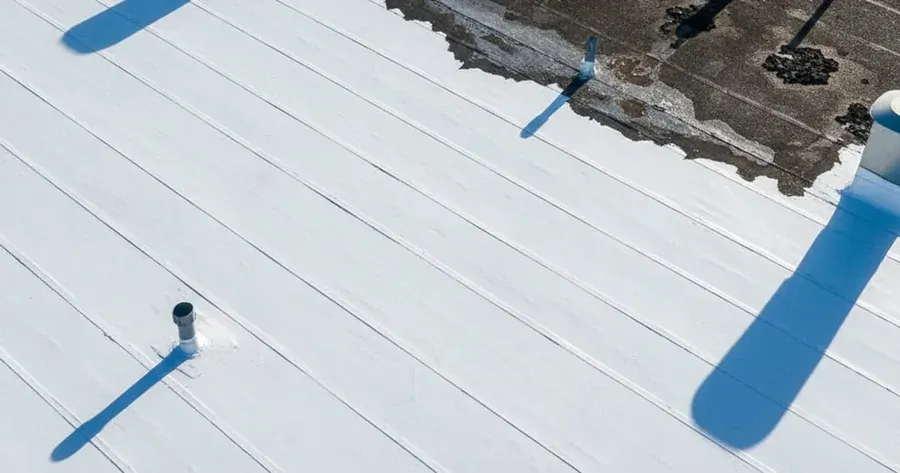
Roof Inspection Before Commercial Property Purchase: What Buyers Miss
-
Where Due Diligence Falls Short
-
What a Pre-Purchase Inspection Covers
-
Wet Insulation: The Hidden Cost
-
Interpreting Remaining Useful Life
-
Using Findings in Negotiations
A commercial property acquisition involves dozens of line items in due diligence, but the roof rarely gets the attention it warrants. The standard property condition assessment—a PCA performed to ASTM E2018—identifies roof age and visible surface condition, and produces a replacement reserve estimate based on that age. What it doesn’t do is tell you whether the roof has wet insulation, whether it’s tracking toward the end of its useful life faster than the age-based estimate suggests, or whether the manufacturer warranty has been voided by improper repairs or missed compliance inspections.
Those are not marginal details. On a 200,000-square-foot industrial facility with a 17-year-old TPO membrane, the difference between “needs monitoring” and “needs replacement within 18 months” is the difference between a $0 capital item in your underwriting and a $1,400,000 capital event in your first year of ownership. The pre-purchase roof inspection is the only tool that answers that question before close.
Where Standard Due Diligence Falls Short
ASTM E2018 property condition assessments are designed to identify items that require immediate remediation and estimate 10-year capital reserves. They are not designed to perform the depth of roof investigation that an acquisition warranting a significant purchase price deserves. The PCA inspector typically performs a visual survey of accessible surfaces, records the membrane type and approximate age from available documentation, and uses age-based life expectancy tables to project a remaining useful life estimate.
The problem is that age is not a reliable proxy for condition. A 15-year-old TPO roof on a well-maintained, conditioned building in a low-solar-exposure climate may have 8 to 10 years of remaining useful life. The same age roof on a dark-colored building in Texas with a history of deferred maintenance and active leaks may have 18 months. Without non-destructive moisture testing, without a seam-by-seam visual inspection, and without a maintenance history review, the PCA inspector has no way to distinguish between those two conditions—and the life expectancy estimate is the same either way.
“We’ve done pre-purchase inspections where the PCA said five to seven years remaining and we found 30 percent wet insulation. That’s not a five-year asset—it’s an immediate capital requirement. The buyers who didn’t commission a separate roof inspection before those deals closed had a very different year-one experience than they modeled.”
What a Pre-Purchase Roof Inspection Covers
A pre-purchase inspection is the most comprehensive inspection type in the commercial roofing service menu. Unlike a routine maintenance inspection—which focuses on current deficiencies and repair priorities—a pre-purchase inspection must answer the question of what the roof will cost the new owner over the first 5 to 10 years of ownership.
The inspection scope includes: a complete visual surface assessment of all accessible areas with photographic documentation; non-destructive moisture testing via infrared thermography (and nuclear verification of anomalies) to map wet insulation extent; a review of all available maintenance records, prior inspection reports, and warranty documentation; an assessment of the drainage system including drain body condition and flow path verification; evaluation of all flashings, penetrations, and edge conditions; and an assessment of HVAC equipment anchor conditions relative to the roof system.
The deliverable is a condition report with a remaining useful life estimate, a wet insulation map with quantified area, a full deficiency list with repair cost estimates, and a 10-year capital projection distinguishing between repair spend in years 1–3 and replacement cost in the projected replacement window. That 10-year capital projection is the input that goes into acquisition underwriting.
Wet Insulation: The Hidden Cost That Changes Acquisition Math
Wet insulation is the single finding most likely to materially change the financial profile of a commercial acquisition. Unlike surface deficiencies—open seams, failed flashings, drainage blockages—wet insulation is invisible without non-destructive moisture testing. The standard PCA does not include moisture testing. The result is that wet insulation is routinely carried as “deferred maintenance, monitor” in the PCA reserve estimate when it should be classified as “immediate capital requirement, replace.”
The math on wet insulation is straightforward. On a 100,000-square-foot building with 25 percent wet insulation (25,000 square feet), the insulation replacement cost at $1.80 to $3.50 per square foot adds $45,000 to $87,500 to the re-roofing project cost. But the timing implication is more significant: a roof with 25 percent wet insulation is typically approaching the end of the period where repair and coating investment makes sense. That means the replacement timeline—which the PCA reserve estimate projected at 7 to 10 years—may be 2 to 4 years. That’s a 5 to 7 year acceleration of a major capital event, and the carry cost of that acceleration at current interest rates is material in any acquisition model.
Interpreting Remaining Useful Life Estimates
Remaining useful life estimates in inspection reports are probability-weighted assessments, not guarantees. A qualified commercial inspector will provide an estimate with a confidence range—“8 to 12 years under continued maintenance” or “3 to 5 years if moisture infiltration is not addressed within 12 months.” Reports that give a single year without qualification should prompt a follow-up call.
The estimate is most reliable when it’s based on: documented membrane installation date and manufacturer, non-destructive moisture testing results, evidence of regular maintenance (inspection reports, repair records), and regional UV and thermal load factors that affect the specific membrane type. Silicone-coated TPO in a shaded Northern climate has a fundamentally different remaining life trajectory than uncoated EPDM in direct Texas sun without maintenance history.
For acquisition purposes, use the bottom of the range as your underwriting assumption. The inspection report represents a moment-in-time snapshot; the actual pace of deterioration between close and replacement depends on weather events, occupancy patterns, and whether maintenance commitments made in the assessment actually get funded after close.
Using Inspection Findings in Negotiations
A documented pre-purchase inspection is a negotiating asset, not just a risk assessment. When the inspection identifies material deficiencies—wet insulation, failed drainage systems, near-end-of-life membrane condition—those findings support three negotiating positions: a purchase price reduction reflecting the cost of immediate capital work; a seller escrow credit for identified repairs to be completed post-close; or a seller repair obligation prior to close as a condition of the purchase.
Which approach is appropriate depends on the deal structure and the seller’s motivation. In a competitive acquisition with multiple bidders, a request for a price reduction based on inspection findings may lose the deal. In that case, the inspection findings serve a different purpose: they inform your underwriting and your post-close capital plan so you don’t have a surprise in year one.
Warranty Transferability and Contractor Disclosure
Many commercial roof manufacturer warranties are transferable to a new owner—but the transfer requires a formal request to the manufacturer, submission of a current inspection report, and in some cases a roof repair to bring the system into compliance before transfer is approved. The transfer window is typically 60 to 90 days post-close. Missing that window typically voids the transferability option permanently.
Before close, request the warranty documents from the seller and determine: the manufacturer and warranty type (no-dollar-limit vs. total-dollar-limit coverage), the original installation date and warranty term, whether prior repairs were made by the manufacturer-certified contractor (non-certified repairs void most manufacturer warranties), and whether the warranty is transferable and what the transfer fee is.
If the warranty is valid and transferable, it represents real value—typically $0.30 to $0.80 per square foot of remaining coverage—that the acquisition price should reflect. If the warranty has been voided by non-certified repairs or missed compliance inspections, that loss of value should be accounted for in underwriting. Understanding how to interpret the full inspection report that documents warranty status is covered in our guide on how to read a roof inspection report.
The pre-purchase inspection is a small spend relative to the acquisition it informs. A full scope inspection including moisture testing on a 100,000-square-foot commercial property costs $4,000 to $8,000. The capital risk it quantifies can run to seven figures. Commission the inspection during the due diligence period, before the inspection contingency expires, so findings can inform negotiation. Don’t treat it as a post-close formality—by then, the leverage is gone.
Pre-Purchase Commercial Roof Inspection
Pro Exteriors provides acquisition-grade commercial roof inspections with moisture mapping, warranty verification, remaining useful life estimates, and 10-year capital projections. Serving the South-Central and Mountain regions.
What Happens During a Commercial Roof Inspection: A Step-by-Step Walkthrough
Infrared vs. Visual Roof Inspections: When Each Method Is the Right Tool
How to Read a Roof Inspection Report: A Facility Manager’s Field Guide
For the service page this article supports, see commercial roofing contractor.
Related reading: /blog/roof-maintenance-plans-whats-included/ and /blog/roof-design-considerations-warehouses/.