

commercial roofing
7 Common Causes of Commercial Roof Damage — and How to Ca...
Ponding water, membrane shrinkage, improper drainage — the seven failure modes that account for most commercial roof claims, with inspection triggers for each.
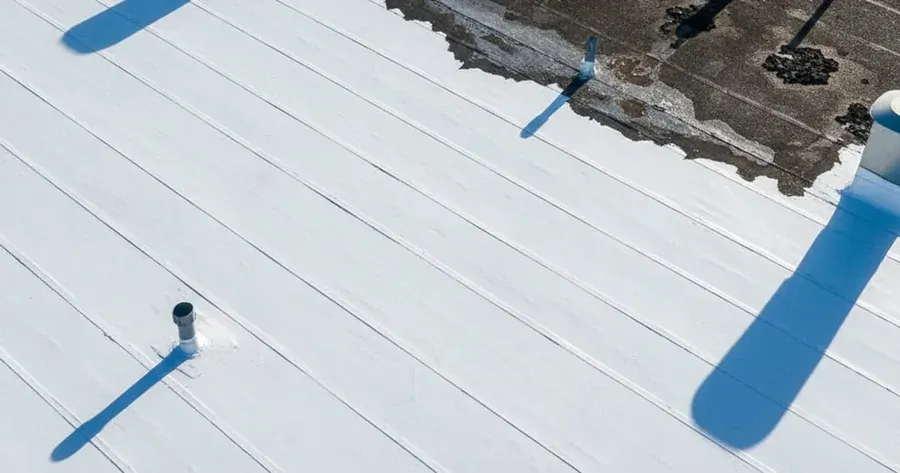
7 Common Causes of Commercial Roof Damage — and How to Catch Them Early
Most commercial roof failures are not sudden events. They are the cumulative result of one or more failure modes that went undetected through several inspection cycles. The good news: every one of these causes has early warning signs that are visible to a trained eye — and catchable before water ever reaches the building interior.
Understanding what actually breaks commercial roofs is the first step toward a maintenance program that extends system life and keeps insurance claims off your record. Here are the seven causes that account for the overwhelming majority of commercial roof damage across flat and low-slope systems.
1. Ponding Water and Drainage Failure
Ponding water — defined by most roofing standards as standing water that remains on a roof surface 48 hours after rainfall stops — is the single most common accelerant of commercial roof deterioration. It adds weight the deck was not designed to carry (water weighs approximately 5.2 pounds per square foot per inch of depth), degrades membrane materials through sustained UV exposure at the water line, and eventually works its way through seams and around drain collars under hydrostatic pressure.
Early warning signs: Visible surface depressions or “bird baths” on the membrane, debris accumulation rings around drain openings, interior staining near the building’s low points that appears only after heavy rain.
Root cause: Almost always drainage system failure — clogged internal drains, blocked scuppers, or inadequate slope built into the original deck. Secondary cause is structural deflection in older buildings where the deck has sagged between supports.
2. Membrane Shrinkage and Splitting
EPDM and modified bitumen membranes are particularly susceptible to thermal shrinkage over time. As the membrane contracts, it places tension on all termination points — perimeter flashings, pipe penetrations, curb edges — eventually pulling them away from their substrates and creating open seams. TPO and PVC are less prone to shrinkage but can develop seam separation when heat-welded joints were improperly executed during installation.
Membrane splitting typically occurs at seams or at points of high stress concentration: inside corners, around equipment curbs, and at the intersection of vertical and horizontal surfaces. A split membrane is not always visible from walking distance — it often looks like a hairline crack until water has already penetrated and saturated several square feet of insulation.
Early warning signs: Visible pulling or tenting at flashing termination points, whitening or surface crazing along seams, bubbles or blisters in the membrane surface indicating sub-membrane moisture.
“The seams are always where we find the trouble. A membrane body that looks fine at fifteen feet might have multiple compromised laps when you get on your knees and look closely at the weld line. That is where water finds its way in — not through the field membrane, but through joints that weren’t monitored over time.”
3. Flashing Failures at Penetrations and Parapets
Flashings are the transition material between the field membrane and any vertical surface: parapet walls, HVAC curbs, pipe penetrations, skylights, and expansion joints. They are the most labor-intensive element of a roofing installation and, statistically, the most common source of active leaks. A 2024 NRCA analysis found that flashing-related failures accounted for 38% of all commercial roof leak claims.
Flashing fails for several reasons: improper installation technique (particularly at inside corners, which require specific fold geometry), UV degradation of caulk and mastic used to seal terminations, differential movement between the building structure and the membrane, and simple age-related delamination of base and counter flashings.
Inspection trigger: Any penetration added to the roof after original installation — HVAC units, conduit runs, new plumbing vents — should receive a dedicated flashing inspection within 30 days of installation and annually thereafter. Field-added penetrations are frequently done without roofing contractor supervision and create immediate leak vulnerability.
Commercial roofs are work surfaces. HVAC technicians, antenna crews, solar installation teams, and maintenance personnel all access them regularly — often without any awareness of what roof system they are walking on or how to traverse it without causing damage. Single-ply membranes (TPO, EPDM, PVC) are particularly vulnerable to puncture and compression damage from sharp tool edges, dropped equipment, and foot traffic concentrated on the same path over time.
The damage pattern from foot traffic is often a straight line of micro-punctures and seam stress running from the roof access point to the rooftop equipment served most frequently. These micro-punctures do not leak immediately — they become leak points when the membrane flexes under thermal cycling and the puncture opens under tension.
Prevention: Install walkway pads along all established maintenance routes. Require any contractor accessing the roof to check in with facility management and use designated paths. Document every roof access event in the building’s maintenance log.
5. HVAC Equipment Vibration
Rooftop HVAC units generate constant low-frequency vibration that transfers directly into the roof deck through equipment curbs. Over time, this vibration fatigues the flashing material at the curb perimeter, works loose the fasteners that secure the curb to the deck, and can cause the curb base to separate from the field membrane. Units that are out of balance — a fan blade damaged by debris, for example — generate far more vibration than a properly maintained unit and can cause curb flashing failure within a single season.
6. Storm Impact: Hail, Wind, and Debris
Texas, Colorado, and Kansas sit in some of the most hail-active geography in North America. A hail event with stones 1.5 inches in diameter or larger can bruise TPO and EPDM membranes without creating immediately visible tears — but the bruised areas have compromised tensile strength and will become leak points within one to three thermal cycles. Wind-driven debris creates similar impact damage, while sustained high winds at parapet edges can lift and partially separate membrane termination bars.
The insurance dimension is critical here. Most commercial property policies have a claim reporting window — commonly 12 to 24 months post-event — and some carriers require documented storm response to validate a claim. A post-storm roof inspection within 48 hours of an event is not just good practice; it is the step that preserves your right to file a claim if damage is confirmed later.
For a full walkthrough of commercial roof repair after storm events, including what to document and how to work with adjusters, see our emergency response guide.
7. Deferred Maintenance Compounding
This is the failure mode that converts a $2,000 repair into a $40,000 replacement. Every one of the six causes above has a window where intervention is inexpensive and effective. Missed, each one compounds: a blocked drain leads to ponding, which accelerates membrane fatigue at seams, which creates micro-failures that allow water into the insulation, which saturates and degrades the insulation R-value, which leads to deck corrosion, which ultimately requires full tear-off and replacement of the deck itself before a new membrane can be installed.
The compounding math is brutal. A $600 drain service left undone for two seasons becomes a $15,000 insulation replacement. That same insulation saturation, left another two seasons, becomes a $60,000 deck and membrane replacement. No roofing budget survives deferred maintenance compounding at scale.
The solution is structured, documented inspection on a bi-annual cycle — spring and fall — with a written scope for every item found and a defined resolution timeline. Our guide on emergency roof leak response covers what happens when deferred maintenance finally results in an active failure. The goal is to never need that guide.
Cost of Repair vs. Cost of Neglect — Typical Compounding Scenario
None of these seven failure modes are unpredictable. They follow consistent patterns, leave consistent early warning signs, and respond to consistent interventions. A roofing partner who shows you the early warning — not just the bill for the result — is the one worth keeping.
Schedule a Commercial Roof Inspection
Pro Exteriors provides written inspection reports with photographic documentation, repair scopes, and priority rankings — so you know what to fix now and what to watch over the next 12 months.
Emergency Commercial Roof Leak Response
Flat Roof Repair Methods Explained
Roof Repair vs. Replacement Decision Guide
For the service page this article supports, see commercial roofing contractor.
Related reading: /blog/compliance-inspections-commercial-buildings/ and /blog/commercial-roof-replacement-cost-guide/.